
Enter product details (such as color, size, materials etc.) and other specific requirements to receive an accurate quote.
leave a message
If you are interested in our products and want to know more details,please leave a message here,we will reply you as soon as we can.
other
What Is an IC Test Handler?IC Testing, Handling and Sorting Process Explained

What Is an IC Test Handler?IC Testing, Handling and Sorting Process Explained

June 24, 2026

12+ years of experience in die bonding, wire bonding, molding, and IC packaging automation. Focused on helping manufacturers improve packaging yield and production efficiency.
David Chen - Technical Consultant | Semiconductor Packaging Solutions
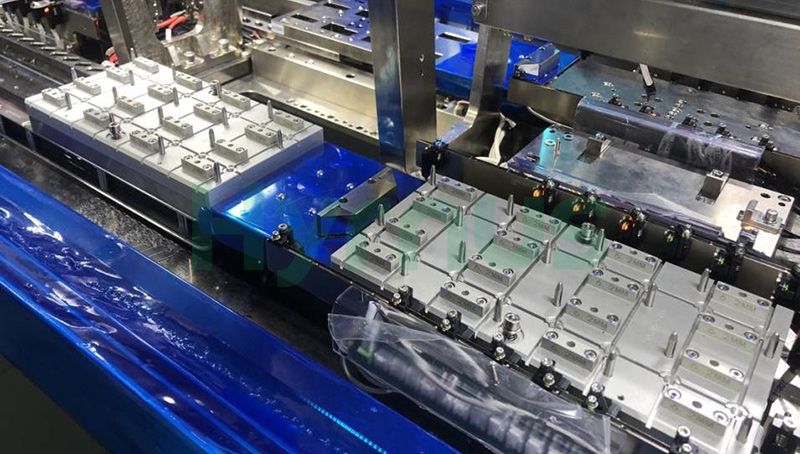
IC testing and sorting are among the final and most critical quality-control stages in semiconductor manufacturing. Even when chip design, wafer fabrication, assembly and packaging are completed successfully, each device must still undergo electrical verification before shipment or integration into an electronic system.
A complete test cell does more than simply measure electrical parameters. It also loads, transports, positions, temperature-conditions and classifies devices according to the test results. 
   
IC Test Handle
  
Table of contents
  • The roles of testing, handling and sorting
  • How a typical IC test cell works
  • The differences between wafer sort and final test
  • The complete operating process
  • Common test items
  • The main types of test handlers.


What Is an IC Test Handler?
An IC test handler is an automated system that transports packaged semiconductor devices to and from a test station. It presents each device to a test socket or contactor, maintains the required orientation and test conditions, receives the test result from the tester, and then sorts the device into the correct output category.
The handler does not normally generate the electrical test signals by itself. Electrical stimulus and measurement are performed by automated test equipment (ATE), while the handler is responsible for physical device movement, precise positioning, temperature conditioning and result-based sorting.


Testing, Handling and Sorting: What Is the Difference?
    
Term Main Function Typical Tasks
Testing Verifies the electrical and functional performance of the device. Applies electrical signals, measures parameters, runs functional patterns and determines pass/fail results.
Handling Moves and positions devices throughout the test process. Loading, orientation detection, transfer, temperature conditioning, socket insertion, contact control and unloading.
Sorting Classifies devices according to the test results. Pass/fail separation, performance grading, parametric binning and customer-defined output bins.


Why IC Testing and Handling Are Important?
   
1. Ensure Product Reliability
Electrical testing identifies open circuits, short circuits, excessive leakage, abnormal current, timing errors and functional failures before devices are shipped to customers.
  
2. Support Performance Grading
Devices from the same production lot may differ in speed, voltage range, power consumption or other parameters. Binning allows qualified products to be assigned to appropriate performance grades and applications.
  
3. Improve Manufacturing Yield and Cost Control
Wafer-level testing can prevent defective dies from entering unnecessary packaging steps. Final testing identifies defects or performance deviations after packaging and helps prevent unreliable products from reaching the market.
  
4. Meet Application-Specific Quality Requirements
Automotive, industrial, medical, communications and aerospace applications often require tighter test limits, wider temperature coverage and complete data traceability.
  
5. Provide Feedback for Process Improvement
Test data can reveal abnormal trends and help engineers optimize wafer fabrication, die attach, wire bonding, molding and other assembly processes.


How Does an IC Test Cell Work?
 
A typical packaged-device test cell consists of four closely connected elements:
  • Automated Test Equipment (ATE): Generates electrical stimulus, measures device responses and executes the test program.
  • Test Handler: Loads, transfers, orients, temperature-conditions and sorts the devices.
  • Test Socket or Contactor: Provides the electrical interface between the packaged device and the load board or test system.
  • Control and Data Software: Coordinates the equipment, records results, manages bin definitions and supports traceability.


For wafer-level testing, a wafer prober moves the wafer and aligns each die with a probe card. For packaged devices, the handler places each device into a socket or contactor connected to the ATE system.


Wafer Sort vs. Final Test
  
Item Wafer Sort Final Test
Test Object Individual dies before singulation and packaging Packaged ICs or discrete semiconductor devices
Main Handling Equipment Wafer prober / wafer sort system IC test handler
Electrical Interface Probe card contacting die pads or bumps Test socket or contactor contacting package leads, balls or pads
Main Purpose Identify known-good dies and create a wafer map before packaging Verify electrical performance after packaging and classify finished devices
Typical Output Wafer map and die-level test data Pass/fail bins, performance grades and packaged output in trays, tubes or tape


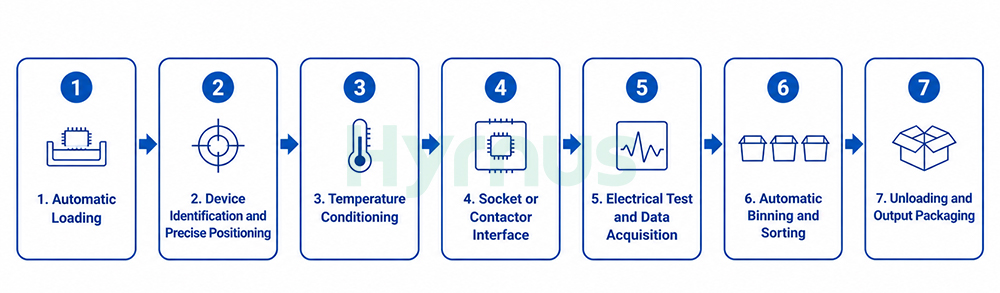
Complete IC Testing, Handling and Sorting Process
IC Testing, Handling and Sorting Process
Step1 : Automatic Loading
Devices are loaded from trays, tubes, bulk feeders, carrier tapes or other input formats according to the handler design.
  
Step2 : Device Identification and Precise Positioning
Vision systems, sensors, pick-and-place mechanisms or turret mechanisms confirm orientation and transfer each device accurately to the test station.
  
Step3 : Temperature Conditioning
When required, the handler heats or cools the device to the specified test temperature and stabilizes it before electrical contact. Room-temperature-only systems may omit this step.
  
Step4 : Socket or Contactor Interface
The device is placed into the test socket or contactor with controlled force and alignment to ensure stable, repeatable electrical contact.
  
Step5 : Electrical Test and Data Acquisition
The ATE system applies electrical stimulus, measures the device response, executes the test program and returns the result to the handler or cell controller.
  
Step6 : Automatic Binning and Sorting
Based on the test program, devices are assigned to pass/fail bins, performance grades, parametric bins or customer-defined categories.
  
Step7 : Unloading and Output Packaging
Sorted devices are unloaded into trays, tubes, tape-and-reel or designated reject containers. Test data and production records can be uploaded to a factory information or MES system.


Common Production Test Items
 
  • Open and short-circuit test
  • Leakage current test
  • Operating voltage and current measurement
  • Static parameter test, such as threshold voltage or on-resistance
  • Dynamic parameter test, such as switching speed, timing and frequency response
  • Functional test using device-specific test patterns
  • Room-temperature, high-temperature or low-temperature testing when required


Common Types of IC Test Handling Equipment
 
Equipment Type Typical Application
Pick-and-Place Test Handler Tray-based ICs, automotive devices, power devices and mixed package types requiring flexible handling
Turret Test Handler High-speed testing and sorting of small ICs and discrete semiconductor packages
Gravity-Feed Test Handler Tube-fed devices with package structures suitable for gravity transport
Strip Test Handler Devices tested in strip format before singulation
Test-in-Tape Handler Integrated electrical testing, sorting and tape-and-reel output
Wafer Prober / Wafer Sort System Electrical testing of dies at wafer level before packaging
Bare-Die or Film-Frame Handler Singulated dies, WLCSP devices and other unpackaged or frame-mounted products


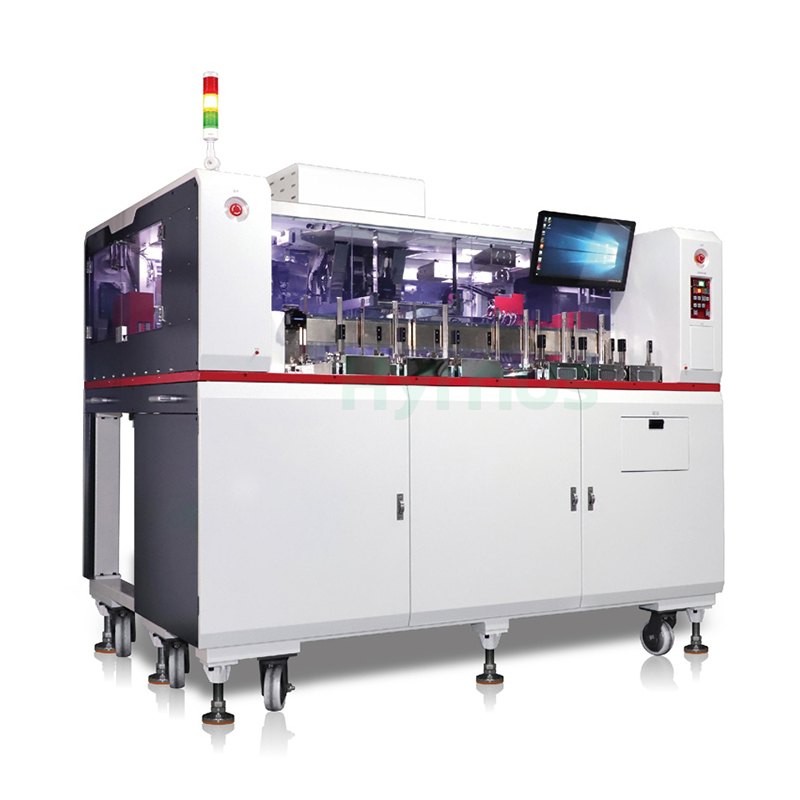
  • Pick-and-Place Test Handle

    Pick-and-Place Test Handle

    The HY-PS308 pick-and-place test handle is suitable for testing and sorting of products such as MSOP, QFN, DFN, LQFP, LGA, BGA, and CSP. 
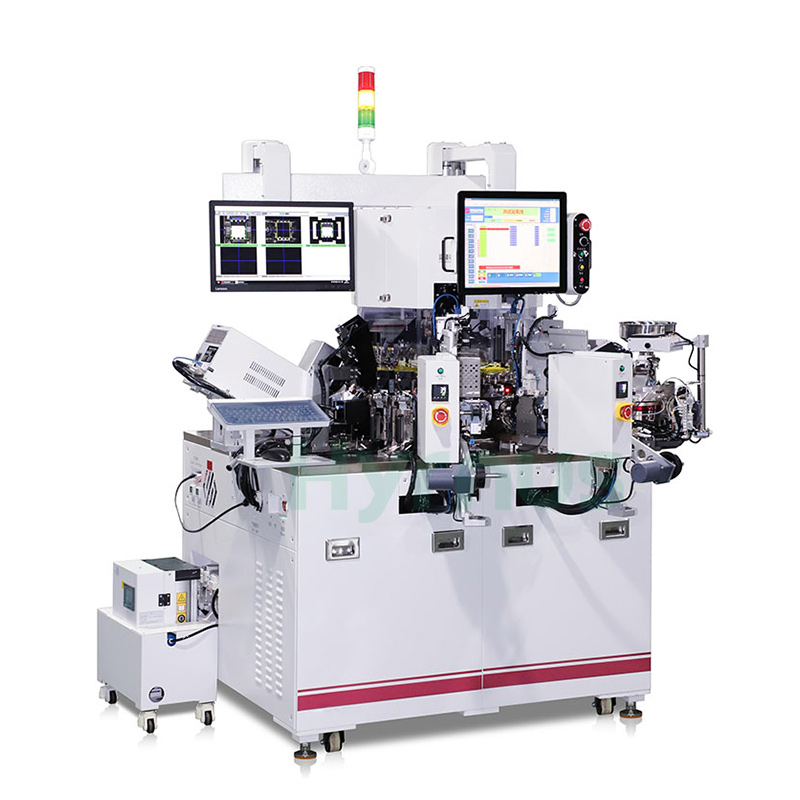
  • Turret Test Handle

    Turret Test Handle

    The HY-TS936H turret test handle is designed for discrete devices and ICs requiring high-temperature testing. It is suitable for packaging such as PDFN, DFN, MSOP, SOT, SOP, SOD, TO, SMA, SMB, SMC, etc.
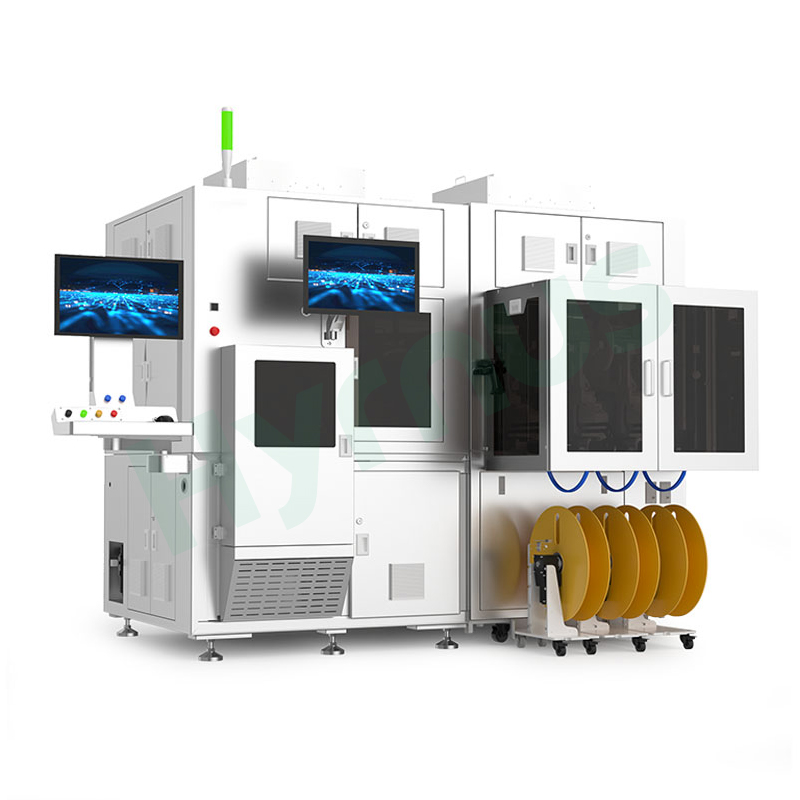
  • Wafer Sorter Machine

    Wafer Sort System

    Tailored specifically for wafer-level die, the HY-WS600 Series integrates wafer-level inspection, high-precision sorting, automated loading/unloading, and data traceability in a single system. 



How to Select an IC Test Handler
The appropriate handler depends on the device package, input and output format, throughput target, required temperature range, test time, number of test sites, contact method, bin quantity, changeover requirements and factory automation interface. The handler should also match the selected ATE system, load board, socket or contactor and production data architecture.
If you have specific requirements for package compatibility, test temperature, throughput, parallel testing or factory automation integration, please Contact HYRNUS. Our experienced engineers will evaluate your testing process and production needs and recommend a suitable test handler solution.


Conclusion
IC testing, handling and sorting work together to ensure that semiconductor devices meet the required electrical, functional and reliability standards. The ATE system performs the electrical measurements, while the IC test handler controls device movement, positioning, temperature conditioning and result-based classification. By combining stable contact, precise handling, high-speed testing and traceable binning, a well-designed test cell helps manufacturers improve product quality, production efficiency and process control.
Latest Blog

leave a message

leave a message
If you are interested in our products and want to know more details,please leave a message here,we will reply you as soon as we can.
Contact us:allen@hyrnus.com